
This article gives you copy-paste subject lines, openers, body phrases, follow-ups, and sign-offs for the moments that matter most in workplace email. The single rule behind every choice: prioritize clarity and one clear next step, meaning a specific action, a named owner, and a deadline. Practicing these phrases in real scenarios turns them into habits faster than memorizing a list ever will.
TL;DR:
- Sending clear and concise requests early in the email increases response rates and reduces confusion, especially when specifying action, owner, and deadline upfront.
- Short, action-focused subject lines of about 5 to 7 words improve visibility on mobile devices and clarify the message's purpose before opening.
- Tailoring greetings and openers to the recipient’s familiarity and context prevents over-formality or casual missteps, improving engagement.
- Replace vague phrases and passive language with direct asks, specific deadlines, and explicit next steps to avoid miscommunication and unnecessary follow-ups.
- Practicing scenario-based replies with feedback helps internalize effective phrases and reduces hesitation in real workplace email exchanges.
Table of Contents
- How to choose and adapt business email phrases
- Subject line phrases: concise, action-first templates
- Opening-line phrases: cold, warm, and internal starters
- Body and request phrases that get a clear answer
- Follow-up phrases that actually move things forward
- Closings and sign-offs that set the next step
- Phrases to retire and what to say instead
- Copy-paste email templates for common situations
- Why these phrases work and how to practice them
- Phrases for responding to complaints or negative feedback
- Phrases for expressing gratitude and appreciation
- Phrases for apologizing effectively
- Phrases for proposing meetings or calls
- Phrases for conveying deadlines or urgency
- Common cultural or tone considerations in business email language
- What actually trips people up in business email
- Turn these phrases into a habit with EmailBetter
- Sources
- FAQ
How to choose and adapt business email phrases
Three quick decisions fix most email problems before you type a single sentence.
First, decide your register. Cold outreach, warm follow-ups, and internal notes to a teammate each call for different greetings and phrasing. A stranger gets more context and formality; a colleague you message weekly does not need "I hope this email finds you well."
Second, put the ask in the first or second sentence. Delivering the purpose early, sometimes called assertive brevity, improves clarity and response rates because the reader never has to hunt for what you want. Name the action, the owner, and the deadline.
Third, keep subject lines short and action-focused, roughly 5 to 7 words or about 42 characters so they don't get cut off on a phone screen. Avoid vague subject lines like "Quick question" or "Following up."
- Match greeting formality to the relationship, not to habit
- Lead with the action, not the backstory
- Cut any subject line word that doesn't describe the task
Pro Tip: Draft your subject line last. Once you know exactly what the email asks for, the subject line practically writes itself.
Subject line phrases: concise, action-first templates
A subject line should tell the recipient what to do or expect before they open the message. These templates work across meeting requests, action items, reminders, and routine business documents.
Meeting and scheduling:
- "Meeting Request: Q3 Budget Review, Thursday 2 PM"
- "Confirming Our Call: Friday at 10 AM"
- "Can We Move Our Meeting to Wednesday?"
Requests and action items:
- "Action Needed: Approve Invoice #4521 by Friday"
- "Quick Input Needed: Draft Proposal by Monday"
- "Decision Needed: Vendor Contract by End of Day"
Reminders and urgent items:
- "Reminder: Feedback Due Tomorrow"
- "Urgent: Server Migration Scheduled Tonight"
- "Deadline Tomorrow: Expense Reports Due"
Informational and routine:
- "Q3 Sales Figures Attached"
- "Update: Project Timeline Revised"
- "Invoice #4521 for January Services"
Capitalize the main words in a subject line and skip punctuation beyond a colon or question mark. Save exclamation points for genuine urgency, not routine updates.
Opening-line phrases: cold, warm, and internal starters
The right opener depends entirely on how well you know the recipient. Cold openers need to lead with relevance, warm follow-ups should reference prior context, and internal notes can skip pleasantries entirely.
Cold openers (first contact):
- "I'm reaching out because [specific reason tied to their work]."
- "We haven't connected before, but I noticed [specific detail about their company or role]."
- "I came across [article/project/post] and wanted to ask about [specific topic]."
Warm openers (existing relationship):
- "Great speaking with you at [event/meeting] last week."
- "Thanks for the update on [project] last week. Following up on the point about [detail]."
- "It was good catching up on the call yesterday."
Internal or peer openers:
- "Quick question about [project name]."
- "Flagging this before end of day."
- "Following up from our stand-up this morning."
- "Sending this now so you have it before the 3 PM call."
Internal messages read better shorter. Nobody on your own team needs a warm-up paragraph before you get to the point.
Body and request phrases that get a clear answer
Vague requests get vague replies, or no reply at all. Replacing hedged language with a direct ask that names the action and a deadline increases the odds of a timely response — for example, "Can you send the Q3 figures by Thursday?" instead of "Whenever you get a chance, it would be great to see those numbers."
Polite but direct requests:
- "Could you send the revised draft by Wednesday?"
- "Would you be able to confirm the budget by end of day Friday?"
- "I need your sign-off on this by 5 PM tomorrow to keep the timeline on track."
Clarifying questions and easy replies:
- "Should I proceed with Option A or wait for your input?"
- "A quick yes or no works. Do you want the January or February date?"
- "Let me know if Thursday or Friday works better, and I'll lock it in."
Attachments and feedback:
- "I've attached the proposal. Could you flag any sections that need revision by Monday?"
- "The report is attached below. Let me know if the numbers on page 3 match what you expected."
Pro Tip: Whenever you attach a file, tell the reader exactly what to look for. "Attached is the report" invites a skim. "Attached is the report. Check the Q3 totals on page 2" invites action.
Follow-up phrases that actually move things forward
A follow-up that just says "checking in" adds nothing new, and readers can tell. Effective follow-ups add value, a deadline, or an easy way out. Offering a redirect, meaning naming who else might handle it, often gets a faster reply because it lowers the cost of responding.
- "Following up with the updated figures I mentioned. Let me know if Thursday still works for review."
- "Wanted to flag that this decision affects the vendor deadline on Friday. Any update?"
- "If this isn't something you handle, could you point me to the right person?"
- "No pressure if now isn't a good time. Just let me know a day that works better."
Three to four spaced follow-ups, each adding something new, are a reasonable ceiling for most situations. Beyond that, switch channels: a phone call or a quick chat message usually works better than a fifth email.
Closings and sign-offs that set the next step
Your sign-off should match the same register as your greeting. Formal messages pair "Dear Mr./Ms. [Last Name]" with a formal close, while informal ones pair "Hi [First Name]" with something lighter, and "Best regards" sits comfortably in between as a neutral professional default.
Formal: "Sincerely," "Yours faithfully," "Respectfully,"
Neutral professional: "Best regards," "Kind regards," "Best,"
Warm or internal: "Thanks," "Talk soon," "Cheers,"
Beyond the sign-off itself, the last sentence should confirm a single clear next step:
- "I'll send the revised draft by Wednesday morning."
- "Please confirm by Friday so I can finalize the schedule."
- "Let me know your availability and I'll set up the call."
Skip abbreviations like "Rgds" or "Thx" for anyone outside your immediate team. They read as rushed in a first or second exchange, even when meant casually.
Phrases to retire and what to say instead
Some phrases have been recycled so often they've stopped meaning anything. Lines like "Please find attached," "Kindly do the needful," and "I hope this email finds you well" now read as filler rather than genuine communication, and some carry a passive tone that can sound evasive.
| Retire this | Use instead |
|---|---|
| "Please find attached" | "I've attached the report" |
| "I hope this email finds you well" | Skip it, or reference something specific |
| "Just circling back" | "Following up on my note from Monday" |
| "As per my last email" | "As I mentioned Tuesday" |
| "Per our conversation" | "Following up on what we discussed" |
| "Kindly do the needful" | "Could you complete this by Friday?" |
| "At your earliest convenience" | "By Thursday, if possible" |
"Just circling back" and "per my last email" both carry a faint edge of impatience without saying so directly. Naming the actual date or action removes the ambiguity and the passive-aggressive undertone in one move.
Copy-paste email templates for common situations
-
Meeting request: Subject: "Meeting Request: Budget Review, Thursday 2 PM." Opener: "Could we schedule 30 minutes Thursday at 2 PM to review the Q3 budget?" Close: "Let me know if that time works, or suggest an alternative." Swap "Could we schedule" for "Let's grab 30 minutes" for a more casual, internal version.
-
Data request: Subject: "Action Needed: Q3 Figures by Friday." Opener: "Could you send the Q3 sales figures by Friday? I need them for Monday's board deck." Close: "Thanks in advance for turning this around quickly." For a more formal version, swap "Thanks in advance" for "I appreciate your assistance with this."
-
Follow-up: Subject: "Following Up: Vendor Contract." Opener: "Wanted to follow up on the vendor contract I sent Tuesday. The renewal deadline is Friday." Close: "Let me know if you need anything else from me to move forward."
-
Delivering bad news: Subject: "Update on Project Timeline." Opener: "Unfortunately, the launch date needs to move to March 15 due to a vendor delay." Close: "I'll send a revised schedule by end of day."
For a quick internal update, a one-line chat message ("Numbers are in, check your inbox") often beats an email entirely.
Why these phrases work and how to practice them
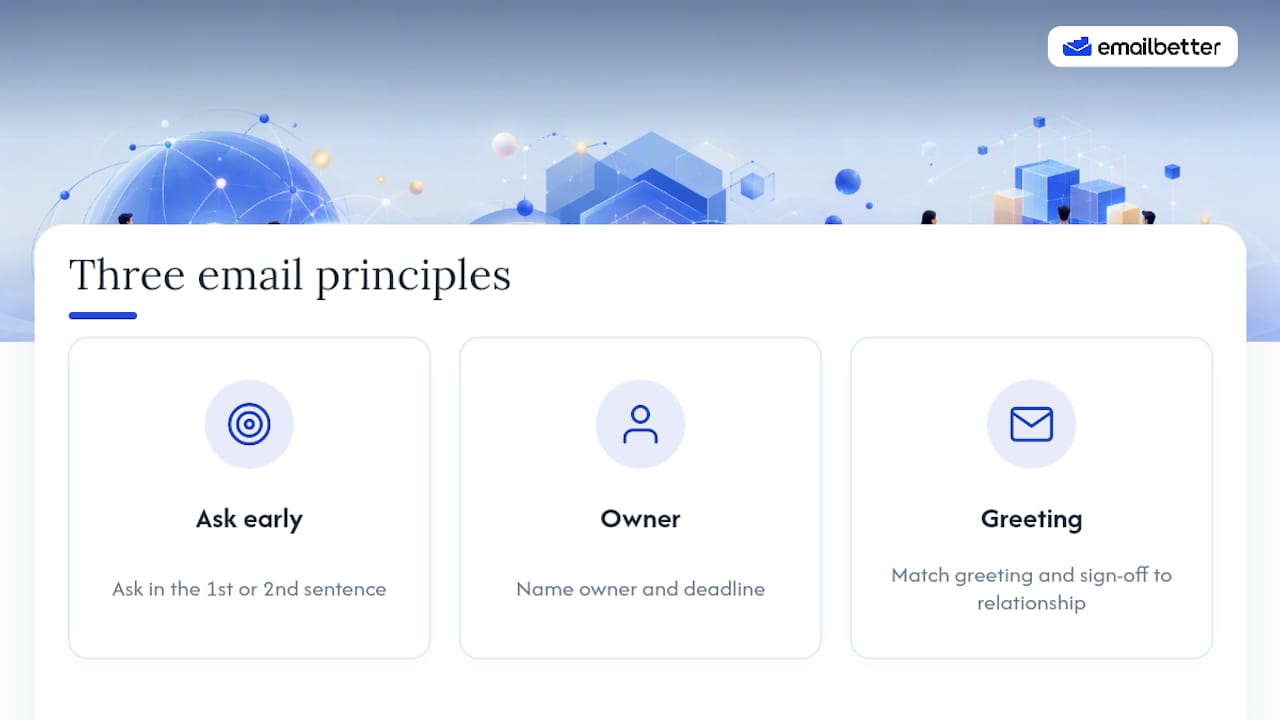
These templates aren't arbitrary. They follow three research-backed principles: put the ask in the first or second sentence, always name an owner and a deadline, and match your greeting and sign-off to the actual relationship rather than defaulting to whatever feels safe.
Reading a phrase list gets you halfway there. The harder part is producing the right phrase under time pressure, in your own inbox, about your own project. Practicing short, contextual replies with corrective feedback turns copy-paste phrases into instinct faster than passive reading, which is the model behind Emailbetter's exercises. If you're a non-native English speaker who second-guesses register or tone, working through realistic business email English scenarios closes that gap faster than a bookmarked list ever will.
Phrases for responding to complaints or negative feedback
The instinct to over-apologize or over-explain usually backfires here. What works is acknowledging the issue specifically, stating what you're doing about it, and giving a timeframe.
- "Thank you for flagging this. You're right that the delivery was late, and I understand the frustration that caused."
- "I've looked into what happened, and here's what went wrong."
- "We're correcting this now. You'll have the updated invoice by end of day."
- "I understand this isn't the experience you expected, and I want to make it right."
- "Here's what we're changing so this doesn't happen again."
Avoid phrases that sound defensive, like "As I explained before" or "That's not actually how it works." Even when technically accurate, they shift blame onto the reader and rarely de-escalate anything. Naming the specific problem, rather than a vague "sorry for any inconvenience," signals that you actually read the complaint. A generic apology reads as a template; a specific one reads as attention.
Close complaint responses with a concrete resolution and a way to follow up if it doesn't land: "Please let me know by Friday if this resolves things on your end." That single line does more to rebuild trust than three extra sentences of apology.
Phrases for expressing gratitude and appreciation
Generic thanks get skimmed and forgotten. Specific thanks get remembered, and they cost you nothing extra to write.
- "Thank you for turning that around so quickly. It made a real difference on our end."
- "I appreciate you taking the time to walk me through this."
- "Thanks for catching that error before it went out. That saved us a headache."
- "Your input on the proposal shaped the final version. Thank you."
- "I wanted to acknowledge the extra effort on this project. It didn't go unnoticed."
The strongest gratitude phrases name the specific action, not just the general gesture. "Thanks for the quick turnaround on the Henderson report" lands better than "Thanks for your help," because it proves you noticed what actually happened.
Gratitude also works well as an opener rather than an afterthought. Leading an email with "Thank you for the detailed notes from yesterday's call" sets a collaborative tone before you move into your own ask. It costs one sentence and changes how the rest of the email reads.
Phrases for apologizing effectively
An effective apology names the specific mistake, avoids passive phrasing, and states the fix. "Mistakes were made" and "I'm sorry if this caused any confusion" both dodge ownership, and readers notice the dodge.
- "I apologize for the delay in getting back to you. I should have flagged this sooner."
- "I'm sorry for the error in the invoice. I've corrected it and attached the updated version."
- "That's on me. I misread the deadline, and I've adjusted the schedule to catch up."
- "I apologize for the confusion my last email caused. To clarify: [specific correction]."
Notice the pattern: each one names the mistake directly, then moves immediately to the fix. Skip the instinct to over-explain why the mistake happened. One sentence of context is fine; three paragraphs of justification reads as an excuse, not an apology.
Where the mistake affected someone's time or money, add a concrete next step: "I've adjusted the invoice and the corrected version is attached" does more work than "I'm very sorry about this." Action closes the loop; sentiment alone doesn't.
Phrases for proposing meetings or calls
The clearest meeting requests state the purpose, propose a specific time, and make it easy to say yes or suggest an alternative.
- "Could we set up 20 minutes this week to go over the proposal? I'm free Tuesday or Thursday afternoon."
- "Would a quick call work better than email for this? I can do Wednesday at 10 AM."
- "Let's grab 15 minutes to align before the client call. Does 2 PM tomorrow work?"
- "I'd like to walk through the budget changes together. Are you free Friday morning?"
Naming a specific time, rather than asking "when are you free," removes a full back-and-forth exchange. It also signals you've already thought about your own schedule, which makes scheduling faster for both people.
When proposing a call instead of continuing over email, say why: "This might be faster to sort out on a quick call" gives the recipient a reason to accept rather than default to another email reply. Always include a fallback: "If none of these times work, let me know what does" keeps the door open without extending the thread unnecessarily.
Phrases for conveying deadlines or urgency
Urgency communicated vaguely gets ignored. Urgency communicated with a specific date and consequence gets action.
- "This needs to be finalized by Thursday at noon to stay on schedule for the client presentation."
- "Please treat this as time-sensitive. We need your sign-off by end of day."
- "The deadline for this is Friday. Let me know now if that's not realistic on your end."
- "This is urgent: the vendor contract expires Monday, so I need your input by tomorrow morning."
Avoid vague urgency markers like "ASAP" or "when you get a chance," paired with words like "urgent," which contradict each other and confuse the reader about actual priority. Naming the actual deadline and, where relevant, what happens if it's missed gives urgency real weight instead of noise.
If a deadline changes or slips, say so immediately rather than letting silence imply it. "Quick update: the deadline moved from Thursday to Friday" costs one sentence and prevents a wasted follow-up email from the other side.
Common cultural or tone considerations in business email language
Business email norms shift more across cultures than most writers expect, and getting the register wrong reads as either overly stiff or oddly casual.
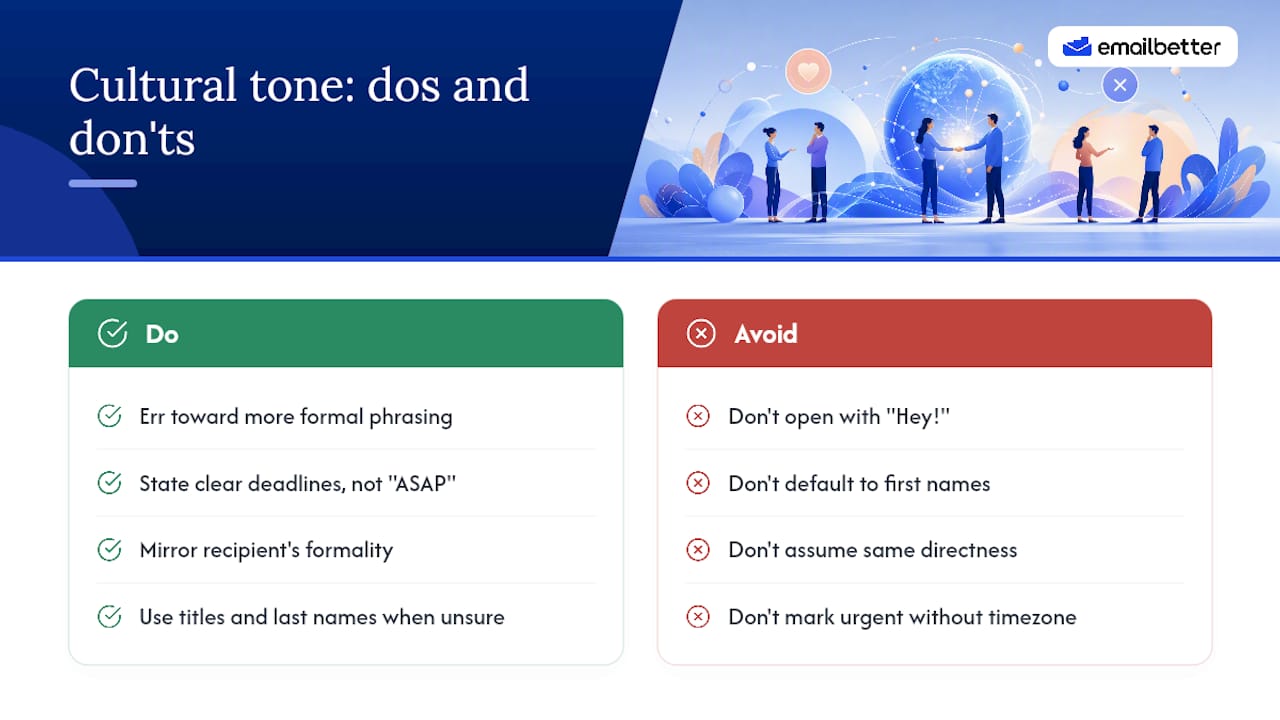
Directness varies significantly by region and industry. Some professional cultures expect the ask stated plainly in the first line; others expect a warmer lead-in before the request appears. When writing to an international colleague or client, err toward slightly more formal phrasing until you know their preference. Overly casual openers like "Hey!" can land as unprofessional in cultures that default to more formal address, even among peers.
Titles and last names matter more in some regions than others. Defaulting to first names with a new international contact can read as presumptuous in contexts where "Mr." or "Ms." plus last name is standard practice until invited otherwise.
Time zones and response expectations also shape tone. A message marked urgent at 6 PM your time may reach someone at 3 AM theirs, so stating an actual deadline rather than "ASAP" avoids putting unfair pressure on someone outside your own working hours.
When in doubt, matching the recipient's own level of formality (mirroring how they signed their last email) is a reliable shortcut that works across most cultural contexts.
What actually trips people up in business email
Most writers over-apologize for asking questions and under-specify what they actually need. The one habit worth building immediately: end every email with a single sentence naming the next action and a date.
— Henrique
Turn these phrases into a habit with EmailBetter
Certain platforms provide a real inbox to practice in, with AI feedback on tone, clarity, and professionalism after every reply you write.
If you're a non-native English speaker or a busy professional who reads guides like this one but still freezes when the actual reply needs typing, scenario-based exercises can help close that gap. You get realistic prompts drawn from real workplace situations, meaning complaint responses, deadline requests, meeting proposals, and the platform tells you specifically what to adjust, not just whether your draft "sounds fine." Guided repetition like this builds clarity and confidence faster than reading templates alone. Try a free exercise at Emailbetter and see how your next reply reads with feedback attached to it.
Sources
- Everyday Email Phrases for Business Communication
- Business Email Phrases: 60+ Lines That Get Replies
- Business Email Grammar Rules in English: Full Guide
FAQ
What makes a good business email?
A good business email states its purpose in the first or second sentence and ends with one clear next step naming the action, owner, and deadline.
What is a good phrase to start an email?
Match the opener to the relationship: lead cold emails with relevance to the recipient, reference prior context in warm follow-ups, and get straight to the point in internal messages.
What are some overused email phrases to avoid?
Retire "Please find attached," "I hope this email finds you well," and "Just circling back." Replace them with specific, direct phrasing like "I've attached the report" or "Following up on my note from Monday."
How often should I follow up before giving up?
Three to four spaced follow-ups, each adding new context or value, is a reasonable ceiling before switching to a call or a different contact.
How can I get better at writing these phrases naturally?
Practicing short, realistic replies with feedback on tone and clarity, the approach Emailbetter uses, builds fluency faster than memorizing a phrase list alone.